Showing posts with label yakuza. Show all posts

Friday, May 02, 2008

NEW JAPANESE BLIND SWORDSWOMAN

Ichi is part of Sochiku Studio's latest line-up, one of the many films they'll be marketing at Cannes. It's a re-working of the Zatoichi formula, only this time the titular hero is a traveling woman shamisen player. Of course she has a sword hidden inside her walking stick. Sounds cool, but judging by recent Japanese television-inflected big studio productions - perhaps the recent Sanjuro remake starring Yuji Oda of Bayside Shakedown fame is one indication - it might not be that promising. Oh yeah, there's also a recent remake of Kurosawa's Hidden Fortress - yes, the film that provided the plot template for the first Star Wars. Anyhow, Ichi is directed by Fumihiko Sori (Ping Pong, Vexille) and stars an idol , the sexy Haruka Ayase. Who doesn't like sexy badasses and the trailer looks slightly intriguing, but this chick doesn't seem to have that innate stoic demeanor of say Kaji Meiko or Shibasaki Ko (who has been called the Kaji Meiko of her generation). Shibasaki recently starred in the Steven Chow produced Shaolin Girl. I guess there she sheds the scary stoic badass skin and reveals a more athletic, comedic side.
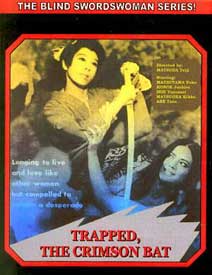
This is not the first Japanese blind swordswoman film.
There was a succesful Shochiku series called the Crimson Bat, starring Yoko Matsuyama, based on a manga by her husband Teruo Tanashita. The original zatoichi is a jidai-geki (period piece) of the chanbara (sword swinging action) genre, though technicaly, because zatoichi is essentially a roving gambler, the films qualify as yakuza eiga. The Crimson Bat gains her sword prowess under the tutelage of a ronin so I suppose it's more samurai than yakuza.According to the synopsis, the heroine in Ichi is at odds with the yakuza, perhaps not unlike the Beat Takeshi Zatoichi.

Monday, March 31, 2008

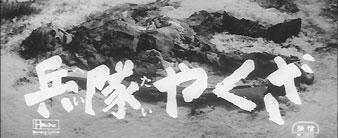
HOODLUM SOLDIER or SADISM MEETS ITS MATCH


Did director Yasuzo Masumura have a personal interest in s & m or did he simply find it metaphorical for the Japanese psyche? Moju (Blind Beast), based on an Edogawa Rampo story, was a cinematic treatise on sado-masochistic desire and its ramifications. Heitai Yakuza (Hoodlum Soldier) (1965) examines Japanese social hierarchy and its s & m leanings through a story of a yakuza serving in the Japanese army, stationed in Manchuria. The yakuza (played by Zatoichi himself, Katsu Shintaro) ends up being a punching bag for almost every senior officer, all who seem to have some kind of chip on their soldier. Because of rank he's not allowed to hit back. But you know that won't last for too long. It must be tough growing up in a country where you always have to answer to someone; where concepts of seniority and superiority are so ingrained in everyday life, from family to school to the workplace and so on, that the subconcious is built for abuse or to dish it out if the chance arises. The screenplay allows Masumura to question this behavior, seemingly di rigeur for the society as a whole (imagine CEOs verbally lambasting sallarymen and senpai - kohai ijime). A subversive voice emerges through the relationship between the yakuza and an idealistic conscientious objector officer that befriends and protects him. There are Lots of beatings and fights, because the yakuza naturally is a real scrapper and takes on several men at the same time. Quite compelling and it spawned several sequels. We can thank Ian Buruma for selecting it for Asia Society's yakuza film series, which you can read more about in my article here. The whole idea of getting beaten on and then fighting back reminds me of that 70's kung fu trailer that had the tag line "he takes a licking and keeps on kicking." And I think the voice over artist on that was Adolph Caeser.

Friday, March 07, 2008

2 manly men, 1 geisha, lots of brooding and a bloody finish


Asia Society kicked off their yakuza film series, Gamblers, Gangsters and other Anti-heroes, with Tomu Uchida's 1968 version of Koyo Ozaki's oft filmed novel Jinsei Gekijo or Theatre of Life. The complete title of this version is Jinsei Gekijo: Hishakaku to Kiratsune - those are the names of the two protagonists at the end, thus the English translated title of A Tale of Two Yakuza. Series curator Ian Buruma gave an informative introduction, explaining how this was an example of the classical ninkyo yakuza films that were popular in the 60's. He mentioned discovering these films while living in Japan in the 70's and sometimes attending all night yakuza movie marathons. He also related how even the sanctuary seeking audience members who had dozed off would awake at every predictable climactic finale to urge on stars like Ken Takakura. One interesting word of encouragement he said was 'shine' (pronounced 'she nay') or 'die.' These cries weren't fueled by pure blood lust, but since the hero's death was inevitable they wanted him to die beautifully, as Mr. Buruma explained.

The movie is well constructed with meticulous plotting and structural devices, though a little bogged down dramatically. The majority of time is spent on a deliberately paced love triangle. Thankfully there's a stylish explosion of violent action at the end. This is metaphoric and cathartic for the emotional turmoil brought upon the characters by the giri ninjo dilema. Uchida frames interestingly enough on this sound stage production, adding a dash of theatrical and emotional vibrancy while remaining comfortably inside the formula. He also brings out strong performances from the all star cast, which included yakuza film icons Ken Takakura and Koji Tsuruta in the leads. Junko Fuji, who would go on to her own yakuza star turn in the Red Peony series, plays the geisha of their affections.

Saturday, February 23, 2008

Guns are for sissies!


When Ryo introduced Gangster V.I.P. (Burai Yori Daikanbu) last night she mentioned that the print was not as in good condition as the other films in the series had been. Although we've been blessed with near pristine presentations so far, this print turned out to better than she implied. While the color was a little faded, it didn't impede the cinematic bravura director Toshio Masuda injected into the yakuza potboiler formula. The first ten minutes alone were a super high for a retro action addict like myself. A b & w montage flashback tells the sad sack back-story of orphan Goro (played by Nikkatsu superstar Tetsuya Watari - and I swear he was called Goro in Velvet Hustler, plus the protagonist of Branded to Kill is named Goro) then segues into color and a high-pitched action sequence that includes gun play, face-offs and a tandem flip over a banister. Masuda deftly sets a moody tone, peppering the requisite melodrama of the script with terse action. Masuda's craftsmanship is exemplified by kinetic camera work and vibrant staging, as he delivers a serious action flick that retains a sense of humor. While the nature of the genre might seem a little cheesy today, this one still boasts its fair share of cool, playing up the tropes without degenerating into self-parody. It's about a bad-ass coming to terms with his tender side. Watari's Goro character is like the tin man from the Wizard of Oz - he's got a rough exterior but doesn't realize just what a softie he is and that he really does have a heart after all. The ending follows the noir paradigm but allows room for sequels. In fact this was the first of the Burai series. View the trailer here.

The night before I saw another film in the Lin Zheng Sheng series at Anthology (see below) called Robinson's Crusoe. It was not as interesting as the other one, I have to say. Still, it's great to be able to see Taiwanese films, let alone have the director present for a q & a.