At the beginning of the millennium
Celestial Pictures acquired the Shaw Brothers film library, or at least a good chunk of it, including lots of classic kung fu,
wu xia, and other cool genre stuff. There has since been revival series and foreign region DVD releases as well as Shaw Brothers documentaries on cable TV. In the past few years various titles have been licensed to Dragon Dynasty, Image Entertainment and Media Blasters, allowing a slew of Shaw Brothers titles to pepper the DVD shelves. Image recently released
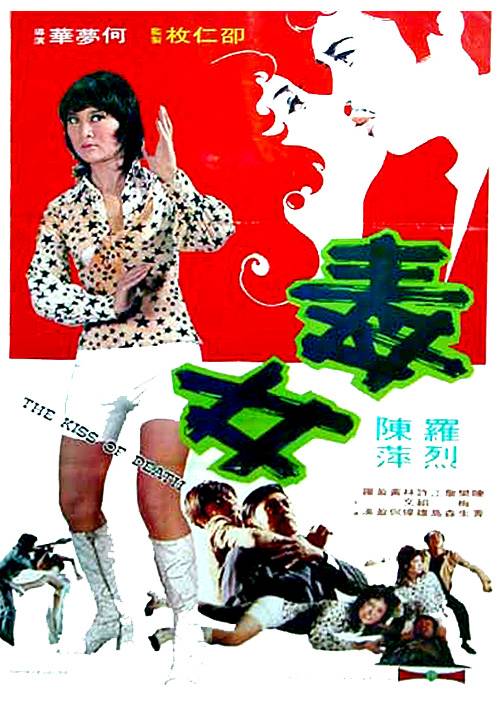
Kiss of Death, a tawdry exploitation film, offering a curious counter to all the standard martial arts fare. Granted this one has martial arts too, but that's not really the focal point of this gruesome venture.
SPOILERS AHEAD - though in this kind of film you pretty much know what's going to happen before it starts...
Kiss of Death is a rape-revenge movie. Ling is a young, attractive and pure factory worker. On her way home from work she is brutally violated by 5 slothering low-life criminals. She makes her way home to the silhouettes of her guardians (not sure if they're her actual parents or aunt and uncle). We only see their shadow through a paper screen as they admonish her for coming home late and say she should work as a bar girl to make more money. Poor traumatized and stigmatized Ling has no one to turn to. The original Chinese title is Du Nu, or "Poison Woman" and it's a double entendre. Soon Ling discovers she's contracted
Vietnam Rose, a notorious strain of syphilis (apparently it's also the name of a
Phillipino soap opera). For the rest of the movie she suffers occasional attacks of the disease, feeling pain down there and treating it by popping some mysterious pills. It's very random and nonsensical, only adding to the gleefully sleazy exploitative thrills. Without giving the whole thing away (wait, what's there to give away?) Ling ends up working as a bar hostess (just as her uncaring caregivers suggested) in order to seek out her attackers and extract revenge. The gimp but badass bar owner, played by Kung Fu movie stalwart
Lo Lieh, becomes her martial arts mentor. The training scenes are pretty entertaining because at first he shows little of that "I don't hit women" attitude, simply knocking her down until she's fierce enough to counter his attacks.
Kiss of Death glides along by the numbers at a typically fervent but deliberate Shaw pace. The melodramatic tones are amped-up : lurid colors shrouded in shadows, super-groovy canned music, and last but not least overwrought emotions Chinese style. The villains, plucked from
central casting (meaning Hong Kong alleyways), are hopelessly sleazy and evil, chewing up the scenery. There's a great psychedelic club scene where the baddies drug a couple of young co-eds and frame them into being sex workers, while our heroine infiltrates the party on her mission of vengeance. Completely ridiculous and devoid of any metaphorical value,
Kiss of Death simultaneously delivers on its promise of (unintentional) high camp and disturbing gritty action.
Kiss is not as imaginative as some of those
pinky violence films, but in some ways it's actually better than the legendary
They Call Her One Eye because that Swedish exploiter is a little too far fetched. It doesn't make sense that the titular One-Eye, played by lovely Lolita
Christina Lindberg, is supposed to be an enslaved prostitute, yet is allowed free time (and salary) to go out and hire men to train her in guns and martial arts to wreak vengeance. It dilutes the tension big time. The fascinating thing about
They Call Her One Eye though, is that the director, like
H.G. Lewis and Dave Friedman did with the gore film, deliberately set out to cash in on a low-budget, taboo-breaking

twisted twist on a fairy-tale. And it worked. Seen in its original 42nd street grindhouse context, the impact must've been ten fold more shocking and entertaining. As for
Kiss of Death, its tawdriness is di riguer for Hong Kong cinema, particularly at that time. Now I have to get my hands on a DVD of
Sexy Killer, the sleazy Hong Kong remake of the
Jack Hill helmed Pam Grier vehicle,
Coffy. Chen Ping, star of both
Kiss of Death and
Sexy Killer, boasts a
filmography chock full of genre and exploitation titles, from the kung fu spaghetti western
The Stranger and the Gunfighter (starring Lee Van Cleef and Lo Lieh) to
The Mighty Peking Man.
 The stream of consciousness continues to flow. The previous post's reminiscence of film flotsam such as Firecracker brought back a flood of video rental memories. For instance, speaking of Firecracker, mention must be made of Raw Force, the zombie martial arts movie made in tandem with the former, also featuring the alluring Kesner in the cast alongside B-movie vet Cameron Mitchell (who might deserve his own post) and a bunch of kung fu no names. This one actually had TV commercials! This brings to mind a film that came out around the same time that never made it on video here and remains shrouded in obscurity, despite its incredible title: Karate Killers on Wheels. This was in New York area theaters circa 1980 or 82 and Joe Bob Briggs raved about it. Still, no one else seems to remember it and it doesn't seem easy to find. From what I've sussed out it's a violent biker~martial arts movie made in 1976 by none other than Shaw Brothers, also released as simply Killers on Wheels. The only sign of any video ever being available seems to be in German (sans subs).
  The Chinese title is "Wu Fa Wu Tian" which means something along the lines of "Totally Unlawful." Celestial Pictures, who now own the Shaw library, have it listed on their website. Wouldn't it be nice if some DVD distributor picks it up? Apparently it features actress Liu Hui Ru, who played 'Princess Dragon Mom' in the incredible Inframan. Back when Sneak Previews was still on channel 13 (public television) and Siskel and Ebert made snarky comments at each other, they did a great 'guilty pleasures' episode on which they featured Van Peebles seminal blaxploitation outcry Sweet Sweetback's Baadasssss Song and the Shaw Brothers cash-in on Ultraman, featuring Bruce Lee imitator Bruce Li (Ho Chung Dao) as the titular Inframan.
  Anyway, the advent of home video in the 80's was the first death knell for grindhouse exploitation pictures. A ripe catalog of juicy taboo-defying genre films made there way into homes. I remember looking at an early video catalog that featured provocative titles such as The 7 Brothers Meet Dracula and The Torture Chamber of Dr. Sadism. The avatars of distribution included major and indie labels, both mirroring the sleazy marketing tactics of exploitation days of yore. Paragon Video remains endearingly carved in the memory for their copious and diverse low-budget fare, big boxes and close to 15 minutes of lurid trailers on every tape. Titles included the gloriously shameless One Armed Executioner, about an Interpol agent on a Death Wish styled mission of vengeance; Lucio Fulci's gratuitously gory The Gates of Hell; Weird run-of-the-mill b-movie fare like Hotwire, a southern fried potboiler about car thieves. Check out this incredible online gallery of vintage VHS box art.