Here's one of their signature tunes. This was used in at least one Japanese TV commercial:
Showing posts with label Japanese cinema. Show all posts
Thursday, March 25, 2010
THE TIGERS DEDICATED TO NAIL
Here's one of their signature tunes. This was used in at least one Japanese TV commercial:
Monday, May 26, 2008
AN EYE FOR AN EYE: REVENGE FILMS
Vengeance is a primal instinct as well as a philosophically rich source of visceral drama. Revenge works in so many varied milieus, from kung fu and spaghetti westerns to corporate espionage and so on. Part of what makes revenge so fascinating is that it is ultimately futile; a vicious circle that may lead to catharsis, but does not necessarily bring about redemption or justice. Nevertheless, retribution fuels countless thrills throughout cinema. Below is the start of a list of various revenge movies. Think of this as a potential syllabus for a class on revenge cinema or maybe worthy of discussion in a book. Please suggest some of your favorite revenge movies.
Rolling Thunder (1977): This tough film slowly boils over in outrage towards
suffering, injustice and the American establishment in the Vietnam era. William Devane plays Major Rane, a returned POW who is honored as a hero by his hometown. However, soon after his homecoming Rane faces horrific tragedy in the face of a gang of greedy lowlifes. Paul Schrader's hardboiled script and John Flyn's taut direction translate angst and anomie into visceral mayhem. Tis a pity there's not an official U.S. DVD available.
Massacre at Central High (1976): This very strange low budget exploitation exercise concerns the dire consequences of bullying in high school. The universe of the film is self contained and detached; adults are never seen for the most part, while the cast appear to be more in their early 20's then actual teenagers. This isolation adds a stirring sense of claustrophobia. The whole production is off kilter and stilted in a way that makes it effectively disturbing. Director Renee Daalder was a protege of Russ Meyer and through Meyer came to work with The Sex Pistols. Daalder designed the "My Way" sequence of The Great Rock And Roll Swindle. Massacre At Central High is definitely a punk rock movie, if not musically both in spirit and aesthetic.
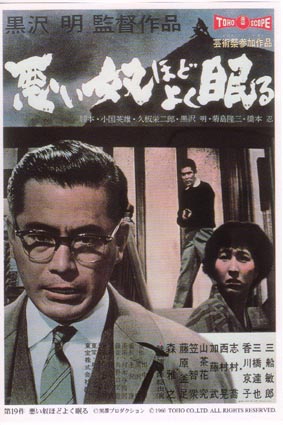
The Bad Sleep Well (1960) is Akira Kurosawa's take on Hamlet. Set in contemporary Japan
with a backdrop of corporate intrigue, the story of a man's climb up the executive ladder unravels a quest for retribution. The links to Hamlet would seem to be patricide, conspiracy, introspection and doom. Kurosawa's always complex construction incorporates some heady social commentary. Apparently some inspiration came from headlines contemporaneous with the production. Kurosawa hits an intensely stirring, bleak tone. Mifune is excellent as always in the vengeance seeking Hamlet role. Kurosawa's sensitivity to human feelings raises complex moral issues. By weaving a tale that transcends the usual physical modes of revenge Kurosawa also defies expectations. The result is a philosophically provocative and cinematically striking thriller.
Do you think director Enzo G. Castellari saw the above Kurosawa film before he made the cheekily inspired spaghetti western Johnny Hamlet (1968)? Apparently it was Sergio Corbucci's idea but he was to busy to realize it into fruition. Therefore Corbucci bequeathed the project onto Castellari. Johnny comes home after fighting in the civil war to find that his father was murdered and his mother married his Uncle Claudio. This is an exploitation film so it is very much about the physical modes of revenge. But so much of the source material is intact, including Hamlet's tortured soul, and, if I remember correctly, he does get visited by his father's ghost. There's an added Gothic tone to the production, wild colors and the like, plus some rowdy fist fights thrown in for macho good measure. The trailer is pretty psychedelic.
Probably the most influential spaghetti western with a revenge plot-line is the Leone masterpiece Once Upon a Time in the West (1968). Haunting theme music enforces the mythical mystique of Charles Bronson's vengeance seeking loner known as 'Harmonica.' And of course Bronson went on to become the icon of revenge for his star turn in the Death Wish films. He publicly denounced the vigilantism of his Death Wish character in the wake of the Bernhard Goetz incident. Death wish director Michael Winner had worked with Bronson 2 years earlier on the revenge tinged action film The Mechanic (1972). The laconic hitman Bronson plays helped seal his on-screen persona of a no-nonsense anti-heroic badass. So the question arises: What is the most identifiable face of revenge floating in our collective consciousness? From the Bronson perspective it would seem to be someone at piece with themselves; someone who understands the meaning of restraint. But circumstances beyond their control exhaust that restraint. In the Mechanic the concept of vengeance is played out more existentially. For Bronson and Jan Michael Vincent's character revenge becomes a game of cat and mouse that defines their lives. Winning the game somehow supersedes the moral and emotional impetus de riguer for the path of vindication.
Perhaps one of the most iconic and beautiful faces of vengeance belongs to the strikingly stoic visage of Kaji Meiko. After establishing herself as an action star in films like Wandering Ginza Butterfly and Nikkatsu's juvenile delinquent Stray Cat Rock series, Ms. Kaji starred in several influential revenge films during the 70's. Lady Snowblood (1973) is an ultra-violent samurai action tale based on an even more violent manga (and was the template for Kill Bill). Perhaps even more impressive (and also based on a manga - Japan has really cultivated comic book ultra-violence) is the Female Convict Scorpion series. These breakthrough women in prison films follow the blood-soaked path of Nami, a woman wronged by the evil and greed of others. They feature some of the wildest, over the top set pieces ever.
Many more coming soon...
Rolling Thunder (1977): This tough film slowly boils over in outrage towards
The Bad Sleep Well (1960) is Akira Kurosawa's take on Hamlet. Set in contemporary Japan
Many more coming soon...
Labels:
exploitation,
Japanese cinema,
samurai,
spaghetti western
Thursday, May 15, 2008
X VERSUS ZERO
Wednesday, May 07, 2008
SEX, VIOLENCE AND WEIRDNESS!
Machine Girl grabbed a lot of attention when its trailer hit Youtube. Did director Noboru Iguchi willfully rip off Rodriguez' potluck pastiche offered up in the Planet Terror half of Grindhouse? Or perhaps the deadly disfigured badass hottie with a gun fever dream has been floating in the ether since the days when They Call Her One Eye enjoyed extended runs in Times Square? This looks like an homage cum send-up of everything from Sukeban Deka to Master of the Flying Guillotine and a barrel of mindless monkey fun at that. Tokyo Shock is releasing the DVD in June. Too bad these sort of films don't get wide theatrical releases anymore. I still have fond memories of seeing a midnight show of Demons.
The team behind Machine Girl already have a new gross-out action epic, Tokyo Gore Police. It's directed by Yoshihiro Nishimura, the effects man from Machine Girl , and stars Eihi Shiina,
Sex as a mantle for ultra-violence can get exhaustive so it's a breath of fresh air to hear about a new neo-spaghetti western by way of Korea. Kim Ji Woon, the director of the excellent modern noir/Hong Kong action homage A Bittersweet Life, the creepy artsy horror Tale of Two Sisters and the wacky cult wrestling comedy The Foul King is behind this one: The Good, The Bad and The Weird!
It takes place in 1930's Manchuria and involves bandits, militants, and a treasure map. Heartthrob Lee Byung Hun from A Bittersweet Life plays the good, Jung Woo Sung from Musa plays the bad, and that funny pudgy underdog from The Host Song Kang Ho plays the weird.
Friday, May 02, 2008
NEW JAPANESE BLIND SWORDSWOMAN
Ichi is part of Sochiku Studio's latest line-up, one of the many films they'll be marketing at Cannes. It's a re-working of the Zatoichi formula, only this time the titular hero is a traveling woman shamisen player. Of course she has a sword hidden inside her walking stick. Sounds cool, but judging by recent Japanese television-inflected big studio productions - perhaps the recent Sanjuro remake starring Yuji Oda of Bayside Shakedown fame is one indication - it might not be that promising. Oh yeah, there's also a recent remake of Kurosawa's Hidden Fortress - yes, the film that provided the plot template for the first Star Wars. Anyhow, Ichi is directed by Fumihiko Sori (Ping Pong, Vexille) and stars an idol , the sexy Haruka Ayase. Who doesn't like sexy badasses and the trailer looks slightly intriguing, but this chick doesn't seem to have that innate stoic demeanor of say Kaji Meiko or Shibasaki Ko (who has been called the Kaji Meiko of her generation). Shibasaki recently starred in the Steven ChowThis is not the first Japanese blind swordswoman film.
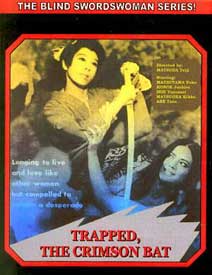
There was a succesful Shochiku series called the Crimson Bat, starring Yoko Matsuyama, based on a manga by her husband Teruo Tanashita. The original zatoichi is a jidai-geki (period piece) of the chanbara (sword swinging action) genre, though technicaly, because zatoichi is essentially a roving gambler, the films qualify as yakuza eiga. The Crimson Bat gains her sword prowess under the tutelage of a ronin so I suppose it's more samurai than yakuza.According to the synopsis, the heroine in Ichi is at odds with the yakuza, perhaps not unlike the Beat Takeshi Zatoichi.
Monday, April 07, 2008
A SAMURAI GLIMPSE INTO THE INFINITE ABYSS
Monday, March 31, 2008
HOODLUM SOLDIER or SADISM MEETS ITS MATCH
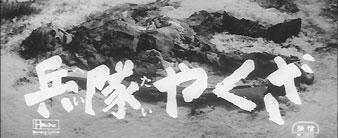
Did director Yasuzo Masumura have a personal interest in s & m or did he simply find it metaphorical for the Japanese psyche? Moju (Blind Beast), based on an Edogawa Rampo story, was a cinematic treatise on sado-masochistic desire and its ramifications. Heitai Yakuza (Hoodlum Soldier) (1965) examines Japanese social hierarchy and its s & m leanings through a story of a yakuza serving in the Japanese army, stationed in Manchuria. The yakuza (played by Zatoichi himself, Katsu Shintaro) ends up being a punching bag for almost every senior officer, all who seem to have some kind of chip on their soldier. Because of rank he's not allowed to hit back. But you know that won't last for too long. It must be tough growing up in a country where you always have to answer to someone; where concepts of seniority and superiority are so ingrained in everyday life, from family to school to the workplace and so on, that the subconcious is built for abuse or to dish it out if the chance arises. The screenplay allows Masumura to question this behavior, seemingly di rigeur for the society as a whole (imagine CEOs verbally lambasting sallarymen and senpai - kohai ijime). A subversive voice emerges through the relationship between the yakuza and an idealistic conscientious objector officer that befriends and protects him. There are Lots of beatings and fights, because the yakuza naturally is a real scrapper and takes on several men at the same time. Quite compelling and it spawned several sequels. We can thank Ian Buruma for selecting it for Asia Society's yakuza film series, which you can read more about in my article here. The whole idea of getting beaten on and then fighting back reminds me of that 70's kung fu trailer that had the tag line "he takes a licking and keeps on kicking." And I think the voice over artist on that was Adolph Caeser.
Friday, March 07, 2008
2 manly men, 1 geisha, lots of brooding and a bloody finish
Asia Society kicked off their yakuza film series, Gamblers, Gangsters and other Anti-heroes, with Tomu Uchida's 1968 version of Koyo Ozaki's oft filmed novel Jinsei Gekijo or Theatre of Life. The complete title of this version is Jinsei Gekijo: Hishakaku to Kiratsune - those are the names of the two protagonists at the end, thus the English translated title of A Tale of Two Yakuza. Series curator Ian Buruma gave an informative introduction, explaining how this was an example of the classical ninkyo yakuza films that were popular in the 60's. He mentioned discovering these films while living in Japan in the 70's and sometimes attending all night yakuza movie marathons. He also related how even the sanctuary seeking audience members who had dozed off would awake at every predictable climactic finale to urge on stars like Ken Takakura. One interesting word of encouragement he said was 'shine' (pronounced 'she nay') or 'die.' These cries weren't fueled by pure blood lust, but since the hero's death was inevitable they wanted him to die beautifully, as Mr. Buruma explained.
The movie is well constructed with meticulous plotting and structural devices, though a little bogged down dramatically. The majority of time is spent on a deliberately paced love triangle. Thankfully there's a stylish explosion of violent action at the end. This is metaphoric and cathartic for the emotional turmoil brought upon the characters by the giri ninjo dilema. Uchida frames interestingly enough on this sound stage production, adding a dash of theatrical and emotional vibrancy while remaining comfortably inside the formula. He also brings out strong performances from the all star cast, which included yakuza film icons Ken Takakura and Koji Tsuruta in the leads. Junko Fuji, who would go on to her own yakuza star turn in the Red Peony series, plays the geisha of their affections.
Saturday, February 23, 2008
Guns are for sissies!

When Ryo introduced Gangster V.I.P. (Burai Yori Daikanbu) last night she mentioned that the print was not as in good condition as the other films in the series had been. Although we've been blessed with near pristine presentations so far, this print turned out to better than she implied. While the color was a little faded, it didn't impede the cinematic bravura director Toshio Masuda injected into the yakuza potboiler formula. The first ten minutes alone were a super high for a retro action addict like myself. A b & w montage flashback tells the sad sack back-story of orphan Goro (played by Nikkatsu superstar Tetsuya Watari - and I swear he was called Goro in Velvet Hustler, plus the protagonist of Branded to Kill is named Goro) then segues into color and a high-pitched action sequence that includes gun play, face-offs and a tandem flip over a banister. Masuda deftly sets a moody tone, peppering the requisite melodrama of the script with terse action. Masuda's craftsmanship is exemplified by kinetic camera work and vibrant staging, as he delivers a serious action flick that retains a sense of humor. While the nature of the genre might seem a little cheesy today, this one still boasts its fair share of cool, playing up the tropes without degenerating into self-parody. It's about a bad-ass coming to terms with his tender side. Watari's Goro character is like the tin man from the Wizard of Oz - he's got a rough exterior but doesn't realize just what a softie he is and that he really does have a heart after all. The ending follows the noir paradigm but allows room for sequels. In fact this was the first of the Burai series. View the trailer here.
The night before I saw another film in the Lin Zheng Sheng series at Anthology (see below) called Robinson's Crusoe. It was not as interesting as the other one, I have to say. Still, it's great to be able to see Taiwanese films, let alone have the director present for a q & a.
Sunday, October 08, 2006
Shogun Assassin DVD
For over a year now I've been writing on film for Brooklyn Rail , a local arts monthly. So far I've written on such topics as Pinky Violence , Spaghetti Westerns , Film Noir , and Asian Films . Below is an excerpt from my Shogun Assassin DVD review that's current at the time of this blog post:
Shogun Assassin (AnimEigo)
In 1980 a couple of enterprising American filmmakers purchased rights to the first two films of the excessively violent Lone Wolf and Cub samurai series—a chronicle of a shogun’s executioner who, framed by his megalomaniacal boss, is on the run with his infant son in a baby cart equipped with secret weapons. The filmmakers, David Weisman (director of the Edie Sedgwick vehicle Ciao Manhattan) and Robert Houston, edited together all the super-violent parts (dismemberments, decapitations, naked female ninja, etc.), rewrote the script around their new edit, and brought in a then unknown Sandra Bernhard to dub all the female parts (for a flat $200 fee), plus Mark Lindsay from Paul Revere and the Raiders to provide the soundtrack. The poster and logo designer’s son did a voiceover as the kid, adding narration to hold together the patchwork story. The result, Shogun Assassin, was a big cult hit for Roger Corman’s New World and is an ultimate example of violent, mind-bending movie-making, a postmodern artifact that foretold the future of exploitation and world cinema...
Shogun Assassin (AnimEigo)
In 1980 a couple of enterprising American filmmakers purchased rights to the first two films of the excessively violent Lone Wolf and Cub samurai series—a chronicle of a shogun’s executioner who, framed by his megalomaniacal boss, is on the run with his infant son in a baby cart equipped with secret weapons. The filmmakers, David Weisman (director of the Edie Sedgwick vehicle Ciao Manhattan) and Robert Houston, edited together all the super-violent parts (dismemberments, decapitations, naked female ninja, etc.), rewrote the script around their new edit, and brought in a then unknown Sandra Bernhard to dub all the female parts (for a flat $200 fee), plus Mark Lindsay from Paul Revere and the Raiders to provide the soundtrack. The poster and logo designer’s son did a voiceover as the kid, adding narration to hold together the patchwork story. The result, Shogun Assassin, was a big cult hit for Roger Corman’s New World and is an ultimate example of violent, mind-bending movie-making, a postmodern artifact that foretold the future of exploitation and world cinema...
Subscribe to:
Posts (Atom)